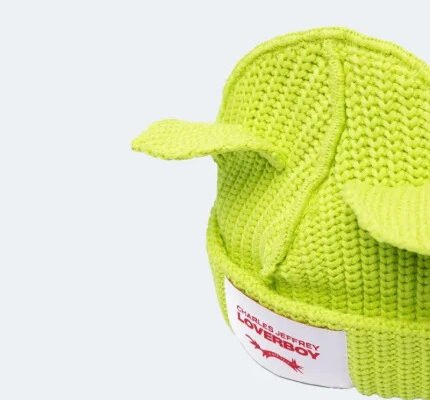
The Loverboy Hat isn’t just a fashion accessory—it’s a declaration of individuality. It’s the kind of piece that refuses to whisper; it shouts, struts, and sometimes, snarls. Crafted with a blend of avant-garde aesthetics and punk undertones, this headpiece has become a cultural emblem for a generation craving rebellion through art. Conceived by the boundary-pushing label Charles Jeffrey LOVERBOY, the hat is instantly recognizable—often in loud colors, wild silhouettes, and crowned with theatrical flair. It’s not meant to blend in. It’s made for those who live on the edge of conformity, just close enough to challenge it but far enough to never fully subscribe.
There’s something intoxicating about the Loverboy Hat’s energy. It has the playful soul of a child scribbling on the walls with crayons and the sharp edge of a punk rocker who never left the underground. In fashion terms, it blurs the line between the runway and the rave. To wear it is to say you’re in on the joke, part of the tribe, but also proudly doing your own thing.
The story of the Loverboy Hat begins with its creator, Charles Jeffrey—a Glaswegian visionary whose design roots run deep in London’s queer nightlife and fashion underground. Before the hat ever made it to high fashion editorials, it was already iconic within Jeffrey’s tight-knit creative circle, most notably featured in his infamous LOVERBOY club nights. These events weren’t just parties—they were performance spaces, runways, workshops, and playgrounds for radical expression. It was here that the DNA of the hat was formed: vibrant, chaotic, conceptual, and unafraid to challenge gender norms or aesthetic expectations.
The hat encapsulates this duality of performance and purpose. It echoes club kid fashion—eccentric, exuberant, and sometimes unhinged—while being carefully constructed with high craftsmanship and couture-like precision. Whether it’s knitted with devil horns, oversized flaps, or playful pom-poms, each hat holds its own character. It’s not just something you wear; it becomes part of your personality.
In an age where streetwear dominance is beginning to fold into something more expressive and boundaryless, the Loverboy Hat offers a welcome escape from cookie-cutter aesthetics. Gen Z, in particular, has adopted it not just for its bold visuals but for what it represents—a rejection of uniformity and a celebration of queerness, creativity, and fluid identity.
This is a generation raised on Tumblr collages, zine culture, and digital drag. The Loverboy Hat fits right in. It offers a piece of clothing that feels personal, like an artifact of inner chaos made visible. It isn’t a logo you wear to gain clout—it’s a visual signal that you exist outside the lines, and you’re proud of it. It calls to fashion lovers who don’t want to be influencers, but iconoclasts. It invites both the introvert in need of armor and the extrovert ready for a spectacle.
Social media helped amplify its cult status. The hat quickly went from being an insider secret to a must-have statement piece, with artists, stylists, and musicians all gravitating toward its magnetic energy. TikTok creators wear it while doing makeup transformations. DJs spin in it under flashing lights. Drag performers reimagine its form to push it even further into surrealism. It’s become less about fashion, and more about storytelling.
There’s something powerful in how the Loverboy Hat effortlessly breaks down fashion’s traditional gender codes. In a world where headwear often signifies status, profession, or cultural lineage, this hat signifies something more personal—freedom. It’s one of the rare accessories that manages to exist in a realm free from gendered design. Men, women, non-binary folks—all find a sense of liberation in its flamboyant energy.
This genderless approach is part of the broader LOVERBOY ethos. The brand doesn’t just make clothes; it creates mythologies. It offers a costume for the dreamer, the drag king, the protester, the poet. And the hat is the crown they all wear. It isn’t just part of an outfit—it’s the beginning of a performance. It has the potential to take someone from a mundane existence into a larger-than-life fantasy.
On the runway, the Loverboy Hat is often styled in extremes. Paired with oversized silhouettes, abstract makeup, and exaggerated accessories, it looks like something out of a punk fairytale. But outside of the high-fashion world, it still thrives—especially among those brave enough to embrace their inner character.
Worn with a vintage trench coat, the hat adds a dose of punk royalty. Paired with a hoodie and flared jeans, it becomes an ironic streetwear twist. Style it with a full LOVERBOY look—bold prints, distressed knits, stacked boots—and you’re channeling pure fashion theatre. Or go the other direction: let the hat be the only statement, a vivid punctuation in an otherwise monochrome fit. No matter how it’s styled, the Loverboy Hat never gets lost in the background. It demands to be seen, photographed, remembered.
At its core, the Loverboy Hat is about visibility—of self, of subculture, of queerness. It’s become a kind of wearable flag, especially within LGBTQ+ communities that have long relied on fashion to signal identity and solidarity. Like the green carnation in Oscar Wilde’s era or the leather cap of Tom of Finland’s universe, the Loverboy Hat adds another chapter to the coded history of queer dress.
It’s also a reaction to fashion’s commodification of queerness. Where many brands adopt rainbow aesthetics for seasonal campaigns, LOVERBOY lives it year-round. The hat, like the brand itself, isn’t interested in surface-level gestures. It’s deeply rooted in queer history, performance art, and resistance. To wear it is to participate in that lineage, whether you’re fully aware of it or just vibing with the energy.
There’s always the risk with statement pieces that they burn bright and fade fast. But the Loverboy Hat seems to have sidestepped that trap. Its appeal isn’t in trendiness, but in timeless theatricality. It doesn’t rely on seasons or hype cycles—it exists in its own imaginative dimension. Much like the Vivienne Westwood orb or the Rick Owens silhouette, the Loverboy Hat is carving out a space in fashion’s permanent archive.
That said, it continues to evolve. New iterations include deconstructed versions, exaggerated devil horns, felted textures, and even collaborations with visual artists. As long as Charles Jeffrey continues to push boundaries—and the fashion world continues to hunger for narrative and rebellion—the hat will live on.
To put on a Loverboy Hat is to step into another world. One where queerness is celebrated, self-expression is sacred, and weirdness is worshipped. It’s not just a hat. It’s a mood, a rebellion, a celebration. It’s the kind of thing that turns a walk down the street into a runway, a trip to the corner store into performance art. In an era of mass-produced fashion and soulless clones, the Loverboy Hat stands defiant—a beautifully absurd, heartfelt reminder that fashion should be fun, fearless, and unapologetically you.